

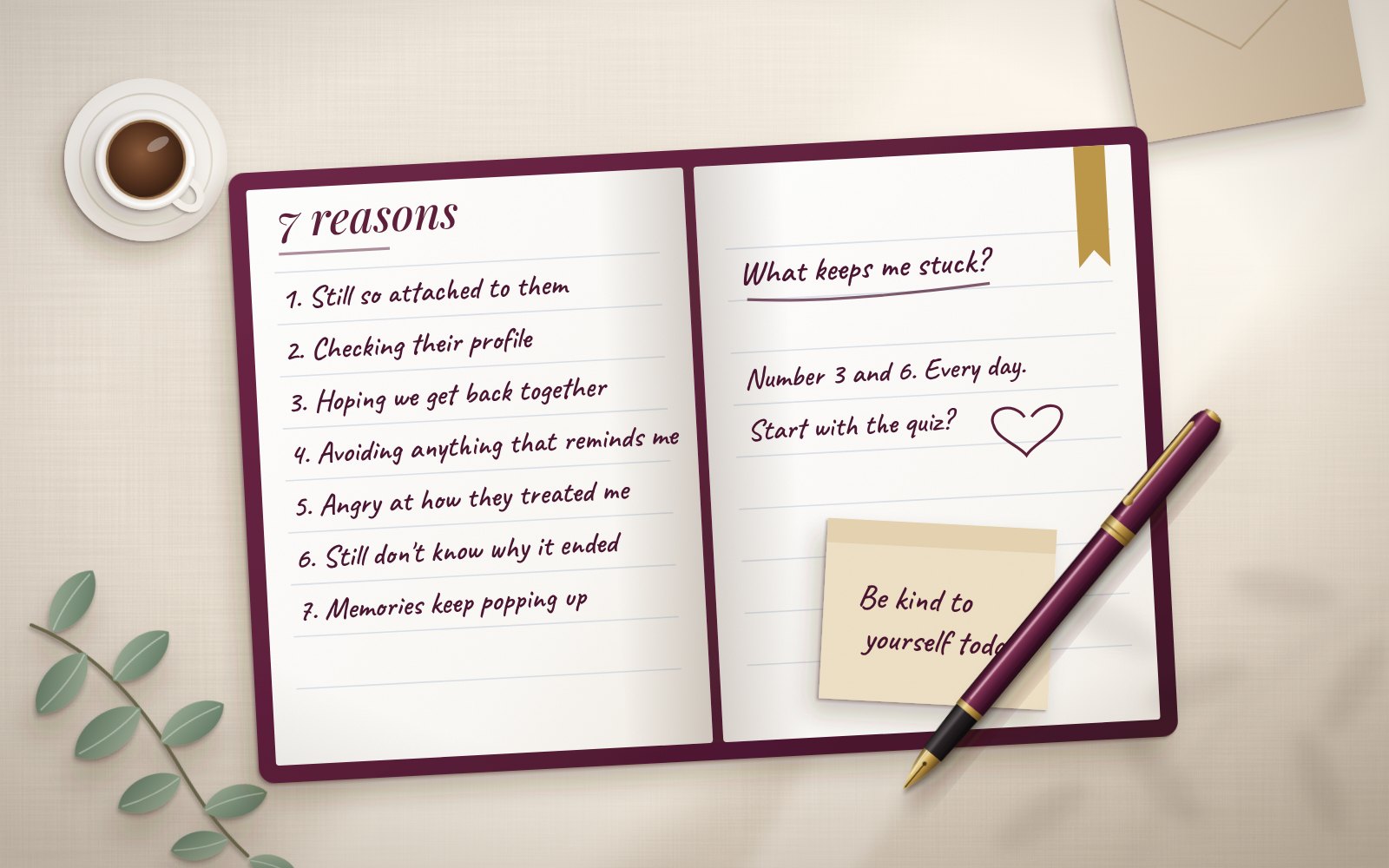
If you have been through a breakup, you know that it can be a painful and lengthy process. Thanks to the study I conducted in 2018, you can now gain insights into what’s preventing you from getting over your breakup.
In my research, I found that 80% of the emotional pain experienced after a relationship breakup is due to these seven reasons:
1. Excessive attachment and connection to your former partner
Over the course of a romantic relationship, we can form powerful bonds with our partners. Naturally, these bonds are hard to sever and forget.
In a study by Kitson and Holmes (1992), around 30% of divorced individuals still had a connection with their spouses. Their attachment was still present even up to four years after the separation.
2. Monitoring your ex or proximity seeking strategies
While some of these seven reasons are more difficult to control, others are almost self-inflicted.
One that’s almost self-inflicted is monitoring or checking on your former partner. Attempts to maintain the bond with your ex are called “proximity behaviors”.
Following your ex’s life via social media can maintain your connection to them, and by doing this, you’re perpetuating your distress. But sometimes you have no choice. For example, you may have to be in contact with your ex because you have children together.
3. Desire for reconciliation
If you didn’t want the relationship to end, or you think you might have made a mistake by ending it, you could have developed an unhealthy desire for reconciliation. But trying to get your ex back is usually a terrible idea.
Why is that?
Successful reconciliations are rare. Very few couples survive the first anniversary after getting back together (Wineberg, 1994).
4. Avoiding reminders of the breakup, upsetting thoughts or feelings
In my study, I found that shutting out distressing thoughts, images or memories is associated with not moving on.
Avoiding reminders also makes getting over your breakup more difficult. Try not to use avoidance if you want to move on. The more avoidance you use, the longer you’ll take to recover.
5. Anger rumination
If you continue to rehash the fights and disagreements that led to your breakup, or dwell on how badly your ex has been treating you, you’re not likely to get over the breakup.
Ruminating angrily after a breakup, separation or divorce is quite common.
First, you have to learn to identify the times when you go over and over anger-provoking situations involving your ex. Then, you need to disrupt this mental process.
6. Rumination about not understanding the reasons for the breakup
It’s easy to feel confused after a breakup. Understanding what led to the breakup may not always lead to a better adjustment (for example, a breakup following an affair).
If you don’t understand why the relationship ended, you may fill the gaps badly, and that may lead to rumination.
In my research, going over the reasons was associated with more distress. You need to accept that you’ll never know the reasons for the breakup with 100% certainty, and move on with your life.
7. Intrusive thoughts, images and memories
Intrusions are upsetting thoughts, images or memories (good or bad) that pop up in your mind without warning. They have the power to take you back in time to that particular situation and make you relive it.
Intrusions are very distressing because they are involuntary and unwanted. If you avoid or try to neutralize your upsetting thoughts, images or memories (for example, by shutting them out or using distraction techniques), you’re making the problem worse.
The more you try to shut out your intrusions, the longer they will upset you.
References
Kitson, G. C., and Holmes, W. M. (1992). Portrait of divorce: Adjustment to marital breakdown. Perspectives on marriage and the family. Guilford Press.
Wineberg, H. (1994). Marital reconciliation in the United States: Which couples are successful? Journal of Marriage and the Family, 56, 80–88.