
I called my study
“A Cognitive Behavioural perspective of emotional distress after a relationship breakup”
(2018, Queen’s University Belfast, UK).
- 255participants experienced a split in the last 12 months
- 120questions were included in the questionnaire
- 31factors were analyzed with statistical methods
- 7years of research involved overcoming many challenges
The biggest finding
Beliefs and behaviors explained most of the heartbreak
If you read as many scientific articles as I have, it can get confusing. One article says that time is the key to recovering from a breakup or divorce. Another points to factors like how satisfied you were in the relationship, your gender, age, sexual orientation, how long you were together, who ended the relationship, or whether you had children. It seems like everything can be important to explain the pain after a breakup.
But if all that were true, my patients would have had no hope of recovering sooner, because those factors were in the past or were characteristics of the relationship that I couldn’t change in therapy.
When I looked at both unchangeable factors and those I could modify in therapy, like how people think or react after a separation, I was relieved to see that there is more we can do to get people unstuck.
The main result from my study is clear: the 13 factors about you and the relationship explained only 20% of heartbreak. When I added the 18 beliefs and behaviors, that rose to 81%.
How much of the heartbreak I could explain
Post-Dissolution Grief scale. Regression analysis. Adjusted R² 19.6% and 81.2%.
The main findings of my study in a 5-page report with graphs, easy to understand.
What kept people stuck, and what helps
The 7 blocks associated with more distress
In my study, each of these stuck points was associated with more distress after a breakup. Which ones sound like you? Start there.
- 1
Obsessing about your ex
Learn to tell the difference between intrusive memories, rumination and worry. Apply the right technique to each of them to stop obsessing.
- 2
Being attached to your ex
The more connected you feel to your ex, the more you’ll miss them. This guide contains 15 techniques that can reduce how much you miss them.
- 3
Analyzing why it ended
Do you really want to know the real reasons for the breakup? Read the letter a patient sent to their ex to learn the truth and their reply. Shocking!
- 4
Hoping to reconcile
Identify the beliefs that keep you hoping to reconcile with your ex, and read a healthier self-talk to stop the roller coaster of false hope.
- 5
Anger rumination
Find out which beliefs keep you stuck in hurtful, anger-provoking situations, and learn how to talk to yourself in a healthier way so you can move on.
- 6
Running away from pain
Reminders about your ex can make you upset again. Use these 11 self-talks to cope with those situations, instead of using avoidance.
- 7
Seeking closeness to your ex
Still keeping tabs on your ex or holding on to their belongings? These two exercises can help you see your ex more realistically and fall out of love.
Not sure which tool to choose?
Start with the quiz to tell you where you’re stuck
20 questions. 3 to 4 minutes. A personal comprehensive report explaining why you’re stuck, leading to more specific free resources to help you move on.
Take the quiz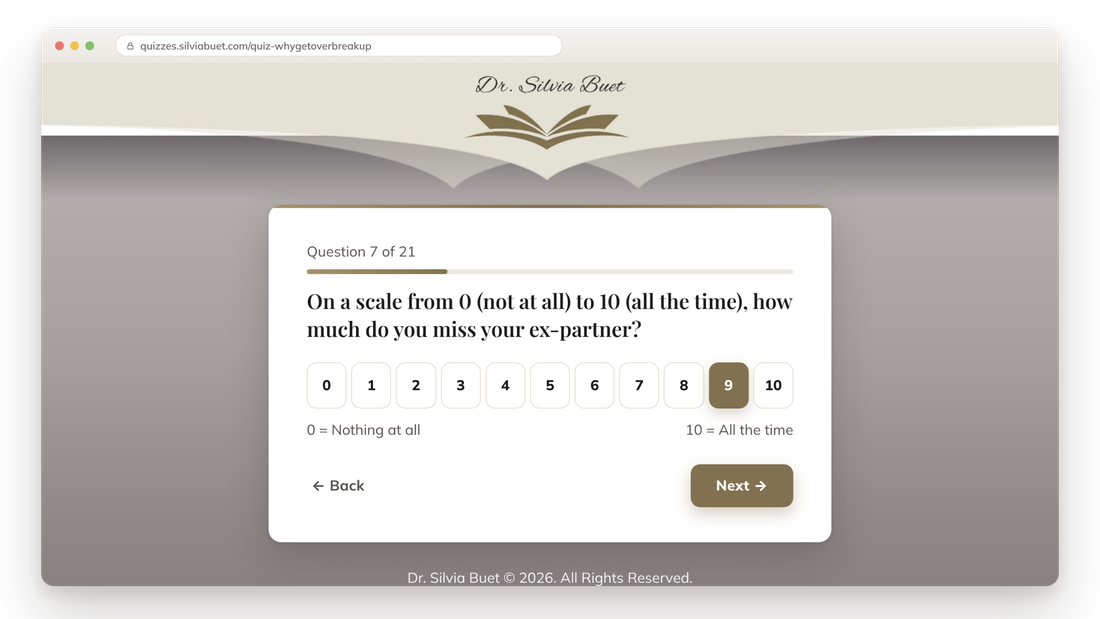 The quiz
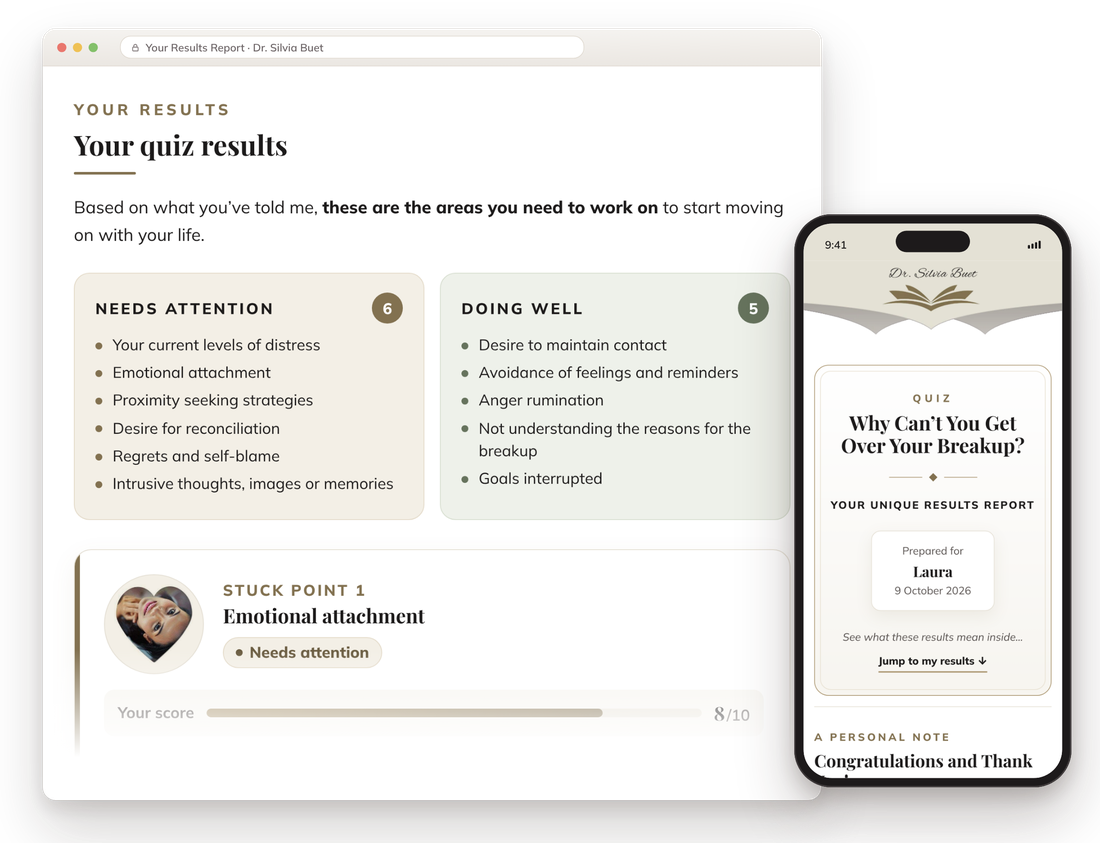 Your report
From the people who took the quiz on my website
Still stuck, years later
In 2021 I looked at the answers of 109 people who took my quiz.
1 in 3 had broken up more than two years before.
Nearly 1 in 3 rated how upset they still were at 10 out of 10.
Two years, and still looking for a way out. Time hadn’t done its job. Because time was never what was missing.
I asked people what they would ask their ex, if they knew the answer would be honest. The same questions kept coming back:
“Why did you really leave me?”
“What did I do? Was it me?”
“Did you ever actually truly love me?”
Good questions. But the answer isn’t what sets you free. Here’s why →
A note on the research. My PhD study was an online survey of 255 adults in the USA, completed at one point in time. It shows which factors went together with more distress after a breakup. It can’t prove that one causes the other. But every one of these stuck points is something CBT can work on. The quiz figures come from 109 people who took my quiz in 2021.
Quiz: Why Can’t I Get Over My Ex?
Find out the reasons why you still feel stuck, not letting go.
Take this quiz to discover how to speed up your recovery process.